Where Do I Find My Clipboard on My Mac?
Answer “where do i find my clipboard on my mac” with current Mac options, privacy checks, shortcuts and a practical recommendation.


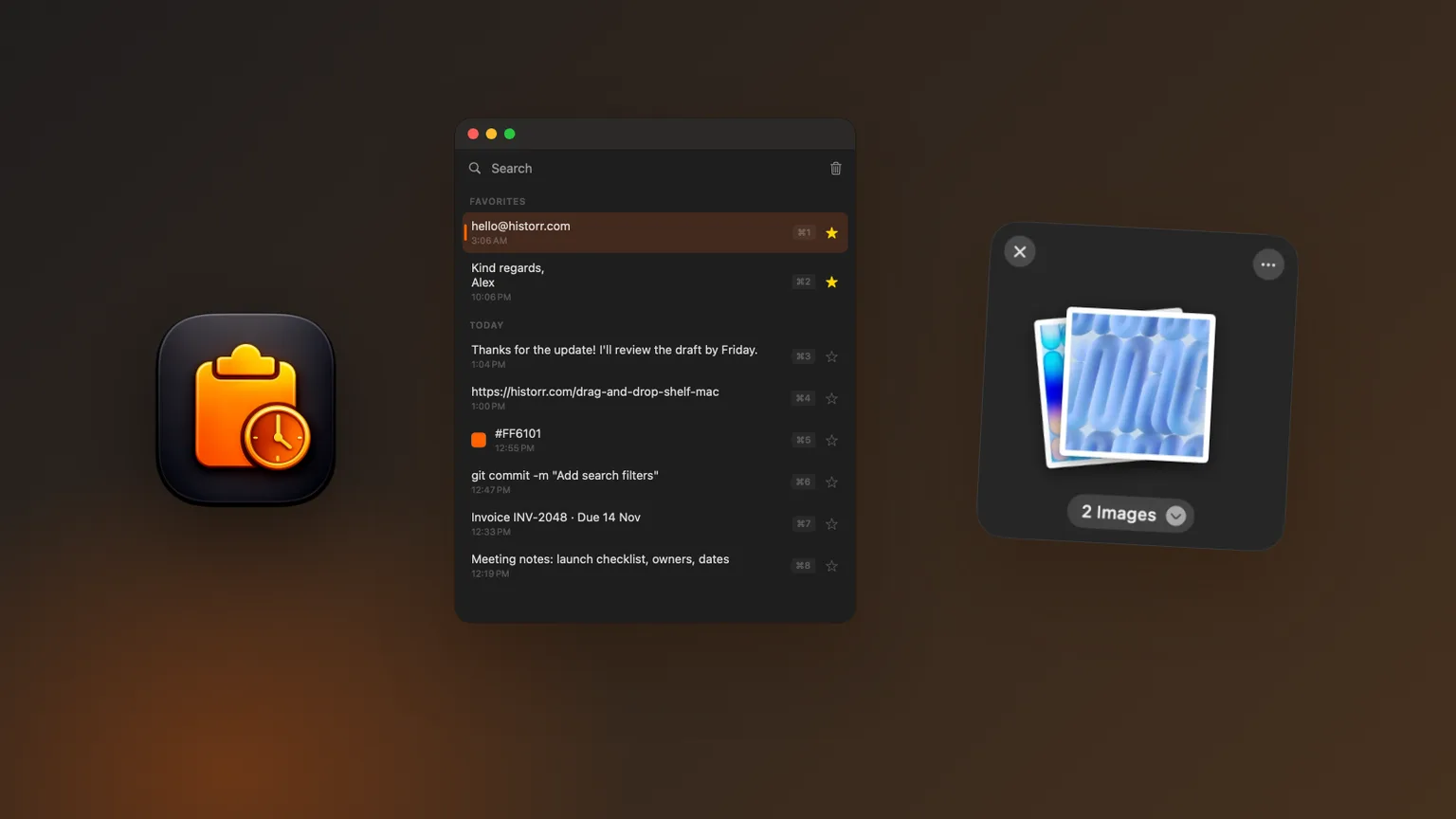
Original Historr editorial artwork using sample data; no private clipboard content is shown.
The short answerUse Command-V for the current item, Spotlight Clipboard history on supported macOS, or Historr's Option-H window for searchable local history. The current clipboard is not a normal folder. Depending on macOS, you can inspect the latest item or open Clipboard history in Spotlight, but copied content is usually accessed through paste rather than Finder browsing.
The overview
For “where do i find my clipboard on my mac,” first decide whether you need to paste the latest item, inspect it, or search older copies. Command-V handles the latest item. Apple documents Clipboard history through Spotlight on supported macOS releases, while a dedicated manager can provide its own searchable history window.
The current clipboard is not a normal folder. Depending on macOS, you can inspect the latest item or open Clipboard history in Spotlight, but copied content is usually accessed through paste rather than Finder browsing. A clipboard is a service used by apps, not normally a Finder folder. The practical interface is the paste command or the history viewer supplied by your macOS version or installed app.
Why it happens
The same word—clipboard—is used for the current pasteboard, cross-device Universal Clipboard and saved clipboard history. They solve related problems but use different interfaces, shortcuts and retention rules.
Apple says ordinary copy and paste uses Command-C and Command-V. On systems with Spotlight Clipboard history, Apple documents Command-Space followed by Command-4. Historr provides a dedicated Option-H shortcut by default and lets users change it in settings.
Your step-by-step guide
Paste the current item
Click the destination and press Command-V. If the wrong content appears, copying another item has already replaced the current clipboard, so you need history rather than the normal paste command.
Open built-in history when available
Press Command-Space, then Command-4 on a supported macOS release. If Clipboard history is unavailable, check your version and system documentation instead of assuming the shortcut is broken.
Open dedicated history
With Historr installed, press Option-H, type a distinctive phrase, move with the arrow keys and press Return to paste. Change the shortcut if it conflicts with another app.
Confirm privacy before daily use
Review where history is stored, what is excluded and how to clear or pause recording. Test with synthetic data rather than a real password, token or payment number.
Common mistakes to avoid
- Choosing from a ranking without testing the actual shortcut and paste flow.
- Using a real password or token to test clipboard privacy behavior.
- Treating clipboard history as a permanent archive or backup.
Small changes. A faster workflow.
- Use a distinctive synthetic phrase when testing search.
- Preview a recovered clip before pasting it into live work.
- Review clear, pause and retention controls before daily use.
Compare your options
| Option | Best for | Limits |
|---|---|---|
| Built-in macOS history | Occasional recent-item retrieval on supported systems | Workflow depth and availability depend on macOS |
| Minimal clipboard manager | Fast keyboard-first history | May omit queues, transforms or file staging |
| Historr | Local history plus Paste Stack, transforms, images and Drag Shelf | Mac only; no cloud sync |
Built-in macOS history
Best forOccasional recent-item retrieval on supported systems
LimitsWorkflow depth and availability depend on macOS
Minimal clipboard manager
Best forFast keyboard-first history
LimitsMay omit queues, transforms or file staging
Historr
Best forLocal history plus Paste Stack, transforms, images and Drag Shelf
LimitsMac only; no cloud sync
Put it into practice with Historr
Historr stores clipboard history locally on the Mac, has no account or telemetry, ignores concealed or transient password-manager copies, and can auto-expire content that resembles card numbers, one-time codes or tokens. Pause Recording is available for work that should not enter history.
Open Historr with Option-H, search as you type, use the arrow keys and press Return to paste. It also remembers images, previews clips with Space, supports plain-text and other transforms, queues ordered values in Paste Stack, and includes a temporary Drag Shelf for files, links, images and text.
Run one repeatable five-minute test before making it part of your workflow. Copy a synthetic paragraph, a URL, an image and a fake token; open history; search for each item; preview the image; paste the safe clips into a blank document; and check how the fake token is handled. Clear the test history, restart the app and confirm the expected result. This small routine turns an abstract recommendation into evidence from your own Mac. If you cannot explain where the clips live, how to remove them or which permission enables pasting, review the documentation before using the app with real work.
- Instant search
- Unlimited history
- Favorites
- Keyboard shortcuts
- Privacy
- Offline storage
- Quick preview
- Paste Stack

Keep your next good idea.
Free, private clipboard history for your Mac.
Questions, answered.
Where do i find my clipboard on my mac?
Use Command-V for the current item, Spotlight Clipboard history on supported macOS, or Historr's Option-H window for searchable local history.
Does macOS include clipboard history now?
Apple documents searchable Clipboard history in Spotlight on supported current releases. Availability depends on your macOS version, and dedicated apps can add different retention and workflow features.
Is Historr safe for sensitive clipboard content?
Historr keeps history locally, ignores concealed password-manager copies and can auto-expire detected sensitive items. Still pause recording before deliberately copying material you do not want stored.
Take it from here
Use “where do i find my clipboard on my mac” as a decision question rather than a hunt for the longest feature list. Use Command-V for the current item, Spotlight Clipboard history on supported macOS, or Historr's Option-H window for searchable local history. Verify the current behavior with synthetic data, keep durable information elsewhere and revisit the choice if your Mac workflow changes.
If you're looking for a faster way to search, organize, and reuse everything you copy, try Historr and see how much time you can save.
Continue with these guides
- Historr documentation
Check shortcuts, images, Paste Stack, privacy controls and Drag Shelf.
- Download Historr
Try the free local clipboard manager for macOS.